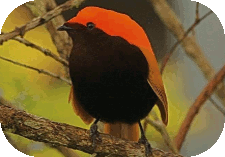
RAMSI is "For
the Birds"
AFAP
Press Release
Click
Here to visit our Solomon Island Bird
The
Regional Assistance Mission, Solomon Islands, better known as RAMSI, has not
only brought peace and order back to the Solomons, but it has had a very important
and welcome side effect, conservation of the nation's rare birdlife. The large birds of Guadalcanal such as
hornbills, cockatoos, parrots and the world's largest member of the cuckoo
family, the Buff-headed Coucal, are staging a major come back in the area
around Honiara since the police have confiscated all the shotguns.
Blyth's
Hornbill, Aceros plicatus
Solomons/New
Guinea Endemic
Shotguns
have always been one of the principle means of shooting the larger birds especially
around the urban and village areas where the occasional parrot could be seen
fleeing for its life. Now every
patch of bush in the capital area seems alive with birds. Pacific wildlife photographer and AFAP
Executive Director, Dr Kevin Vang, who has just been to the Solomons to open
up AFAP's new AusAID Cooperation Agreement, found the change to be very dramatic. He reported that one normally had to go
deep into the bush of Central Guadalcanal before you could see the big endemic
birds in any numbers. "However, I just came from a village area less
than 5 km from the centre of Honiara and saw no less than 25 Buff-headed Coucals
in one tree," Dr Vang said. "Blyth's Hornbills, Ducorp's Cockatoos
and Buff-headed Coucals were more common than I had ever seen, while the many
parrot species were commonly seen in good numbers flying over residential
areas."
Ducorp's
Cockatoo, Cacatua ducorpsii
Solomon's
Endemic
The
Buff-Headed Coucal, the largest member of the worldwide-distributed cuckoo
family, is endemic to the Solomons.
A birdwatcher was happy just to get a brief look at one around Honiara
in the old days. Now they are
everywhere. It is a majestic
bird, which is as graceful as it is ungainly.
"It is like seeing a small pachyderm with wings", Dr Vang
says. It makes a loud and raucous "na-wonk,
na-wonk, na-wonk" which when they all call together creates quite a major
commotion. The people of Honiara
have long forgotten the call of this bird, but increasingly the "na-wonking"
can be heard throughout the back blocks of the town, as the guns, which persecuted
the birds, have fallen silent for nearly a year.
Buff-headed
Coucal, Centropus milo, Solomon's Endemic
Dr
Vang goes on to note that with nearly 70 endemics, 'bird eco-tourism' could
be one of the Solomon Islands largest industries if it were properly developed. It would also be a countrywide boon for
local communities as these avian endemics are distributed across all the major
islands and many of the smaller ones.
Hundreds of thousands of dollars a year could be generated by developing
this eco-friendly industry that would also lead to the conservation of the
nation's forests, Dr Vang said. AFAP
will be working with its local Solomon's partner, Solomon Islands Development
Trust (SIDT) to explore means of developing this industry as well as other
conservation priorities.
Moustached
Treeswift
Hemiprocne
mystacea
Solomons Endemic
AFAP commends RAMSI not only
on their brilliant success with returning the peace and order to the Solomons
but also for the their leadership in bird conservation, even if unintended.
Dr Vang called upon RAMSI to continue supporting the Solomon Islands
Government to help effectively enforce their environmental laws and help stop
illegal logging and other threats to the environment. "They should take
advantage of this important conservation success to build a proper framework
for long-term conservation and sustainable resource management," he concluded.
Mackinlay's
Cuckoo-Dove
Macropygia
mackinlayi
Melanesian
Endemic